
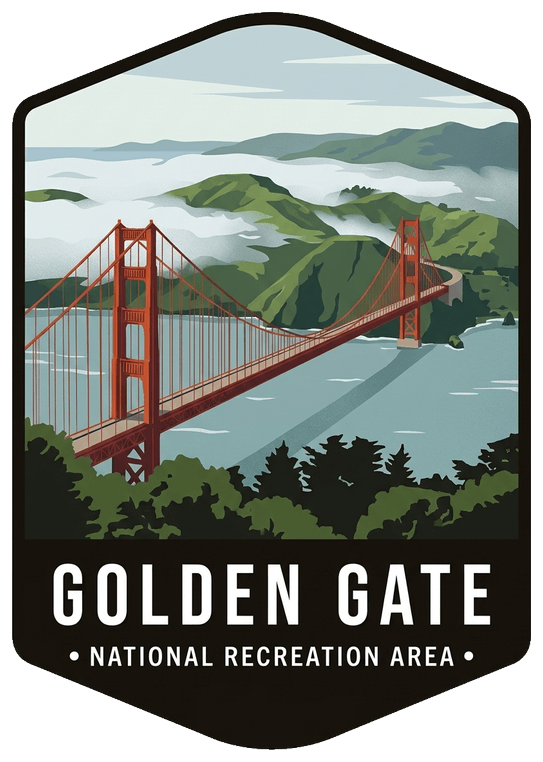
About Golden Gate
Experience a park so rich it supports 19 distinct ecosystems with over 2,000 plant and animal species. Go for a hike, enjoy a vista, have a picnic or learn about the centuries of overlapping history from California’s indigenous cultures, Spanish colonialism, the Mexican Republic, US military expansion and the growth of San Francisco. All of this and more awaits you, so get out and find your park.
On the badge
The red-orange Golden Gate Bridge spanning the strait, green Marin Headlands with fog spilling in off the Pacific.
Planning a visit
Things to do
- Arts and Culture
- Biking
- Mountain Biking
- Camping
- Car or Front Country Camping
- Group Camping
- Fishing
- Saltwater Fishing
- Food
- Dining
- Picnicking
- Guided Tours
- Self-Guided Tours - Walking
- Hiking
Weather
Winter is characterized by sporadic rain and cool weather punctuated by brilliant sunshine. In winter the grass greens. Trees and flowers dormant through winter start blooming in late February or early March and last until May or June. By July, summer fog predominates in most coastal areas of the park. Grasses and plants have now turned to the golden brown and muted grays characteristic of California summer and fall. September and October skies are clear and sunshine is abundant everywhere in the park.
Getting there
Golden Gate National Recreation Area has many sites that span over 60 miles of mostly coastal areas north and south of San Francisco. Park areas can be reached by Highways 1, 101 and 280 from the north and south San Francisco Bay Area, and by Highway 80 from the East Bay. To access park headquarters at Fort Mason, please use the entrance at Franklin and Bay Streets in San Francisco.
Visitor details courtesy of the National Park Service. Official Golden Gate site
 Channel IslandsCA
 Death ValleyCA, NV
 Joshua TreeCA
 Kings CanyonCA
 Lassen VolcanicCA
 PinnaclesCA
 Grand IslandMI
 Hells CanyonOR, ID
 JemezNM
 Lake ChelanWA
 Lake MeadNV, AZ
 Lake MeredithTX