
About Saratoga
In 1777, a large British invasion force met an equally large American army here at Saratoga. After two intense battles, an eight-mile retreat, and a three-day siege, British General John Burgoyne surrendered his entire force. This first ever surrender of a British Army is one of the pivotal moments in determining the outcome of the Revolutionary War, forever changing the future of the world.
On the badge
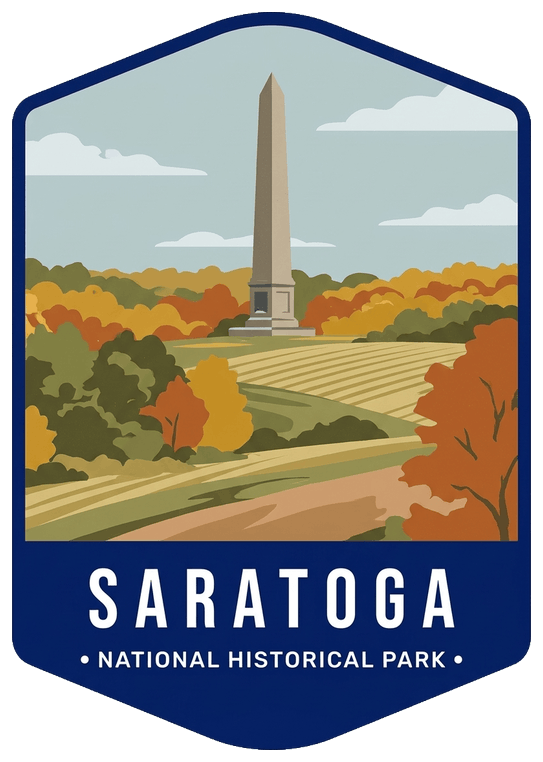
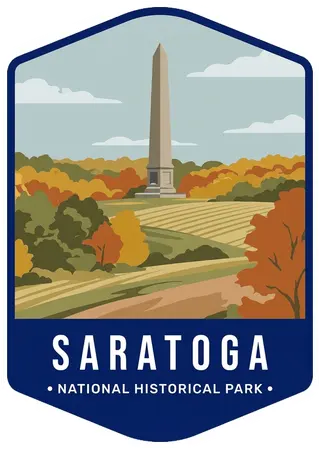
The tall Gothic stone Saratoga Monument obelisk, rising above rolling Hudson Valley farm fields in autumn.
Planning a visit
Things to do
- Arts and Culture
- Craft Demonstrations
- Cultural Demonstrations
- Live Music
- Auto and ATV
- Scenic Driving
- Biking
- Road Biking
- Food
- Picnicking
- Guided Tours
- Self-Guided Tours - Walking
- Self-Guided Tours - Auto
- Hiking
Weather
The park experiences all four seasons. Temperatures can be as low as -20 degrees Fahrenheit in winter and as high as 100 degrees Fahrenheit in summer. Check local weather reports for more detailed information.
Getting there
Saratoga National Historical Park is located between U.S. Route 4 and N.Y. Route 32, about 4 miles north of the Village of Stillwater, N.Y. The park is roughly 40 miles north of Albany, N.Y. and 14 miles southeast of Saratoga Springs, N.Y. More detailed directions, and downloadable maps, are available on our website.
Visitor details courtesy of the National Park Service. Official Saratoga site
 African Burial GroundNY
 Castle ClintonNY
 Eleanor RooseveltNY
 Federal HallNY
 Finger LakesNY
 Fire IslandNY
 SitkaAK
 Ste. GenevieveMO
 Thomas EdisonNJ
 TumacácoriAZ
 Valley ForgePA
 War in the PacificGU