
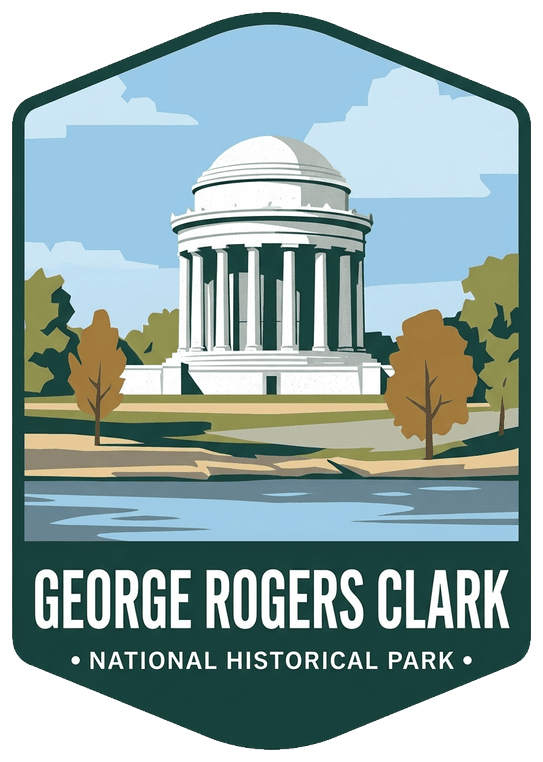
About George Rogers Clark
The British flag would not be raised above Fort Sackville Feb. 25, 1779. At 10 A.M., the garrison surrendered to American Colonel George Rogers Clark. His American army, aided by French residents of the Illinois country, had marched through freezing floodwaters to gain this victory. The fort’s capture assured United States claims to the frontier, an area nearly as large as the original 13 states.
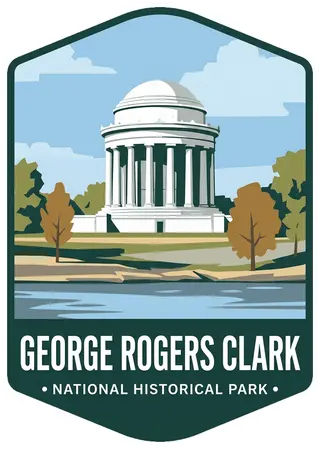
On the badge
The circular white granite memorial ringed by Doric columns beneath a shallow dome, above the banks of the Wabash River.
Planning a visit
Things to do
- Astronomy
- Fishing
- Food
- Picnicking
- Guided Tours
- Self-Guided Tours - Walking
- Hands-On
- Arts and Crafts
- Living History
- Historic Weapons Demonstration
- Junior Ranger Program
- Park Film
- Museum Exhibits
- Shopping
Weather
The weather in the area is quite typical for the Midwest. The average temperature for the winter months is in the mid 30s, but the summers can often be hot and humid with temperatures reaching into the 90s.
Getting there
The George Rogers Clark National Historical Park is located within the city of Vincennes, Indiana. Evansville is approximately 50 miles to the south and Terre Haute is approximately 50 miles to the north. Highway 41 provides good roads from the north or south. Highway 50 provides access from the east and west. From Hwy 50 east and west or from Hwy 41 from the north use the 6th Street exit. On Hwy 41 from the South use the Willow Street exit. From there follow the blue directional signs for the park.
Visitor details courtesy of the National Park Service. Official George Rogers Clark site
 Indiana DunesIN
 Golden SpikeUT
 Harpers FerryWV, VA, MD
 Harriet TubmanNY
 HomesteadNE
 Hopewell CultureOH
 IndependencePA