
About Harriet Tubman
Harriet Tubman was guided by a deep faith and devotion to family, freedom, and community. After emancipating herself and members of her family, she moved them from Ontario, Canada to Fleming and Auburn, New York in 1859. Central New York was a center for progressive thought, abolition, and women’s suffrage where Tubman continued to fight for human rights and dignity until she died in 1913.
On the badge
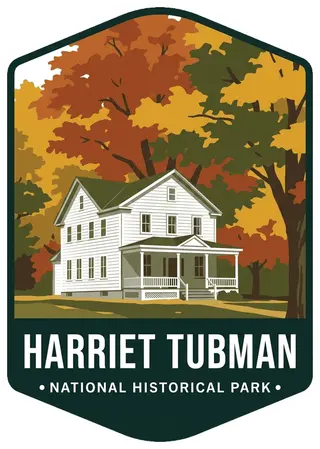
The white clapboard Harriet Tubman Home for the Aged in Auburn with its front porch, beneath tall autumn maples.
Planning a visit
Things to do
- Food
- Picnicking
- Museum Exhibits
- Shopping
- Gift Shop and Souvenirs
Weather
Auburn, New York has four distinct seasons. Fall and spring are usually mild and summers tend to be sunny, warm, and humid. Winter weather is variable and conditions can change quickly. Snow in November is not uncommon. The heaviest snowfall tends to be in January with an average of 33”.
Getting there
Harriet Tubman National Historical Park includes the Thompson Memorial African Methodist Episcopal Zion Church and parsonage. The legislative boundary of the park also includes properties at 180 South Street which are operated by the Harriet Tubman Home, Inc. A related Tubman site separate from the National Historical Park is Fort Hill Cemetery, where Tubman is buried. View directions to these sites on our directions page.
Visitor details courtesy of the National Park Service. Official Harriet Tubman site
 African Burial GroundNY
 Castle ClintonNY
 Eleanor RooseveltNY
 Federal HallNY
 Fire IslandNY
 GatewayNY, NJ
 HomesteadNE
 Hopewell CultureOH
 IndependencePA
 Jean LafitteLA
 Jimmy CarterGA
 KalaupapaHI