
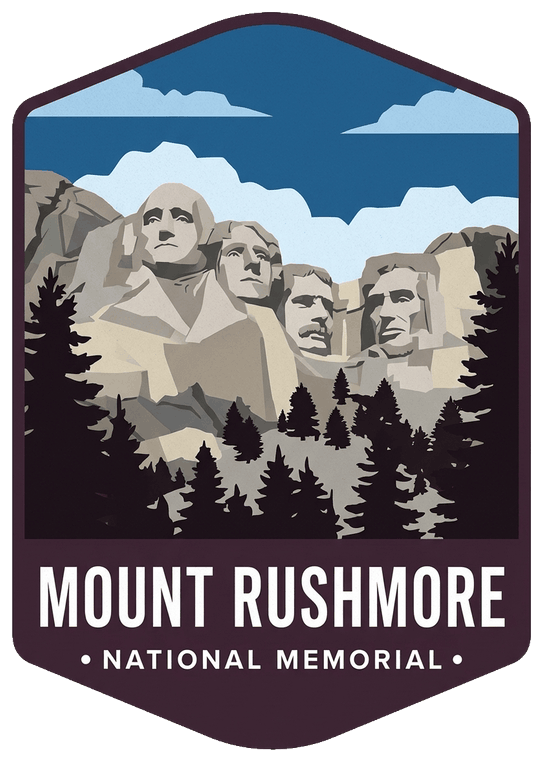
About Mount Rushmore
Majestic figures of George Washington, Thomas Jefferson, Theodore Roosevelt and Abraham Lincoln, surrounded by the beauty of the Black Hills of South Dakota, tell the story of the birth, growth, development and preservation of this country. From the history of the first inhabitants to the diversity of America today, Mount Rushmore brings visitors face to face with the rich heritage we all share.
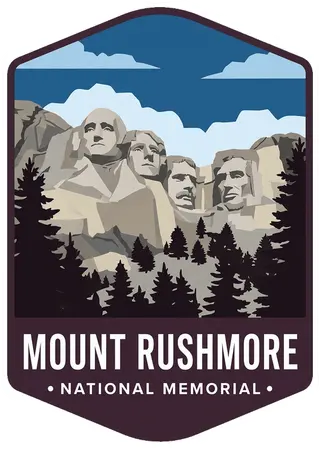
On the badge
The four giant granite presidential faces carved into the mountainside, dark ponderosa pine silhouettes against a deep blue sky.
Planning a visit
Things to do
- Food
- Dining
- Guided Tours
- Self-Guided Tours - Walking
- Junior Ranger Program
- Park Film
- Museum Exhibits
- Shopping
- Bookstore and Park Store
- Gift Shop and Souvenirs
Weather
Weather at Mount Rushmore can be highly variable in any season. Summer high temperatures range from 70 to 100 degrees Fahrenheit. Fall high temperatures range from 45 to 80 degrees Fahrenheit. Winter high temperatures range from 20 to 40 degrees Fahrenheit. Spring high temperatures range from 30 to 70 degrees Fahrenheit. Typically, July and August are the warmest months and January and February are the coldest. March and April receive the most snow, while May and June receive the most rain.
Getting there
Visitors traveling by car from the East use Exit 61 off I-90 and follow the signs for Mount Rushmore National Memorial. Coming from the West use exit 57 exit at Rapid City and follow U.S. Highway 16 southwest to Keystone and then Highway 244 to Mount Rushmore. Visitors coming from the south should follow Highway 385 north to Highway 244, which is the road leading to the Memorial.
Visitor details courtesy of the National Park Service. Official Mount Rushmore site
 CusterMT, SD
 Fort PierreSD
 Grand RiverSD
 Mt. Soledad Veterans MemorialCA
 National D-Day MemorialVA
 National Fallen Firefighters MemorialMD
 National Law Enforcement Officers MemorialDC
 National Memorial to Fallen EducatorsKS
 National Native American Veterans MemorialDC